How to Know If Your Business Is Actually Making Profit
Busy selling but your account is always empty? Here is the simple formula to find your real profit and a step-by-step way to track it every week.


A Nigerian online fashion vendor smiling at her phone in a home studio full of packed orders
To know if your online business is making profit, take the money you actually received and subtract everything you spent to make those sales: the goods, delivery, packaging, ads, data and other running costs. If you only count sales, you are not seeing profit. You are seeing turnover.
That gap is why so many Instagram, WhatsApp and TikTok vendors feel busy all month and still struggle to restock. This guide is for anyone selling online in Nigeria who wants a simple, honest picture of what they are really making.
Disclosure: TechInNaija's founder also built BizUps, one of the tools mentioned below. The free methods in this guide work just as well if you prefer them.
Why busy vendors still feel broke
Most online vendors don't lose money on sales. They lose it on the things they never write down:
The customer who said "I go pay you tomorrow" and never did.
Transfers you can't match to any order.
Delivery fees you paid but forgot to add to the price.
Small amounts taken out for fuel, airtime or lunch.
Each one looks small on its own. Together, they quietly eat the profit you thought you made.
The simple profit formula
Profit = money actually received − (cost of goods + delivery + packaging + ads + data and other running costs)
Here is an example month for a fashion vendor (illustrative numbers):
Total sales: ₦400,000, but only ₦340,000 has actually been paid. ₦60,000 is still owed.
Costs: goods ₦220,000, delivery ₦35,000, packaging ₦10,000, ads ₦30,000, data ₦8,000. Total ₦303,000.
Real profit: ₦340,000 − ₦303,000 = ₦37,000.
The vendor "sold ₦400,000" but made ₦37,000. If they had spent as though they made ₦400,000, the next restock would have been in trouble.
How to track your profit step by step
Separate business and personal money. Use a different account for the business, even a free one on a fintech app. Mixing the two is the fastest way to lose track.
Record every sale the same day. Write the item, price, customer and whether they have paid or still owe.
Record every expense, even the small ones. ₦500 for a nylon or ₦1,000 for data adds up fast.
Match transfers to orders once a week. Go through your bank alerts and tick each one off against a sale.
Follow up on who owes you. A polite reminder within a week recovers far more than one sent after a month.
Check your profit every week, not just at month end. Weekly checks catch problems while you can still fix them.
Three ways to keep your records
A notebook: free and simple, but easy to lose, hard to add up and impossible to check when you are away from it.
A spreadsheet: Google Sheets is free and does the maths for you. It works well if you are disciplined about updating it, but it can be fiddly on a phone.
A bookkeeping app: the fastest option if you sell from your phone all day. You record sales and expenses as they happen and the app works out your profit.
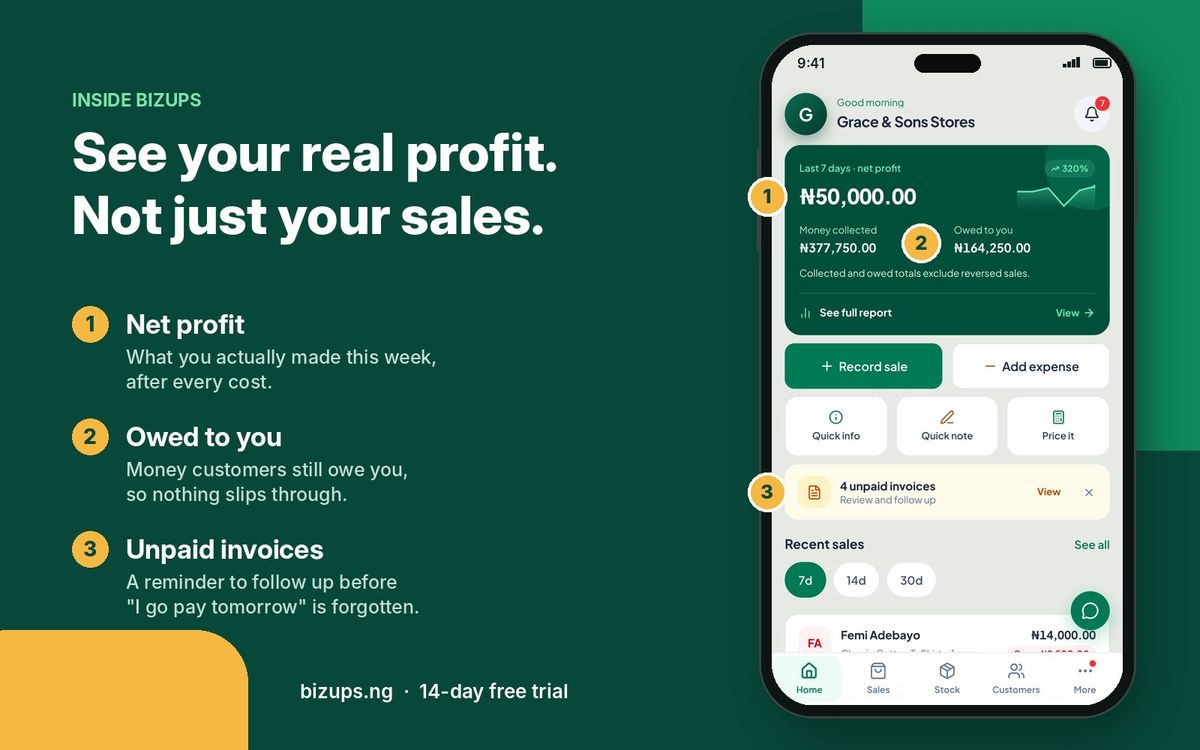
One option built specifically for Nigerian online vendors is BizUps. It was built after watching an online vendor struggle to reconcile sales by hand. You record sales and expenses in a tap, and the home screen shows your net profit, the money you have actually collected and how much customers still owe you, with reminders for unpaid invoices. It has a 14-day free trial. After that you can pay ₦2,500 a month, or ₦150 only on the days you use it.
Whichever method you pick, the best one is the one you will actually keep up every day.
Mistakes to avoid
Counting sales as profit. Sales tell you how busy you are. Profit tells you if the business is working.
Not paying yourself properly. Set a fixed amount you take out each week or month instead of dipping in whenever you need cash.
Forgetting the hidden costs. Data, packaging, transport to the market and failed deliveries are real costs too.
Letting debts pile up. Money customers owe you is not profit until it lands in your account.
What this means for you
You don't need an accountant to know if your business is working. You need ten minutes a day to record what came in and what went out, and ten minutes a week to check the total. Start this week, and by month end you will know your real profit instead of guessing it.
❓ Frequently Asked Questions
What is the difference between sales and profit?
Sales are the total value of what you sold. Profit is what is left after you subtract every cost of making those sales, such as goods, delivery, packaging, ads and data. A business can have high sales and still make little or no profit.
How often should an online vendor check their profit?
Every week. Weekly checks help you spot rising costs, unpaid orders and slow products early, while you can still fix them.
Do I need a separate bank account for my small business?
It is strongly recommended. Keeping business and personal money apart makes it far easier to see what the business is really earning and spending.
What is the easiest way to keep business records on my phone?
A bookkeeping app built for small businesses is usually the easiest, because you can record sales and expenses as they happen. Google Sheets is a free alternative if you prefer a spreadsheet.

Belma
I'm Mujeeb Bello, better known as Belma, and I started TechInNaija to tell the stories behind Nigeria's growing tech scene in a simple, relatable way. I'm Head of Marketing at Scale Through Automation, where I work on AI and business automation, and I spent over five years as a Virtual Assistant helping businesses run their operations and digital tools. I studied Agricultural Education, but curiosity about technology shaped my career. I write for everyday Nigerians, founders, students and anyone curious about tech, so you leave every story knowing why it matters and how it affects you.
More from Belma →📰 Related Stories


